FREE pick & drop from your home · Female instructors only · Online admission from home
WhatsApp 0313 053 6070
Home / Driving Theory
Driving Theory, Explained Properly
Road signs, markings, vehicle basics, parking, road skills and defensive driving. Free to read, written for learners in Abbottabad and Mansehra, and the same material our instructors cover in the car.
Educational material only. Official driving tests and licences are handled by the Khyber Pakhtunkhwa Traffic Police. Sign shapes and colours follow standard conventions; confirm current local regulations with the authority.
Road Signs and Markings
Shape and colour tell you the category before you have read a single word. That is the point of the system.
Warning signs
Triangular, red border
They tell you a hazard is ahead, not what to do about it. Sharp bend, steep descent, narrow road, pedestrian crossing, children, roadworks, falling rocks, level crossing. The correct response to almost all of them is the same: slow down early and be ready to stop.
Regulatory signs
Circular, red border or blue
These carry the force of law. No entry, no overtaking, no parking, speed limits, weight and height restrictions. A circular red-bordered sign is a prohibition; a blue circular sign is a positive instruction, such as a direction you must follow.
Mandatory signs
Blue, circular
Things you must do rather than must not: turn left ahead, keep left, minimum speed, a lane reserved for a particular use. Ignoring one is the same offence as ignoring a prohibition.
Information signs
Rectangular, blue or green
Directions, distances, place names, hospitals, fuel, parking. They do not instruct you, they orient you. Reading them early is what stops the last-second lane change that causes collisions.
Road markings
Painted lines
A solid centre line means do not cross or overtake. A broken line means you may cross when it is safe. Double solid lines apply to both directions. Yellow box junctions must be kept clear. Zebra markings mean pedestrians have priority once they have stepped on.
Driving Basics
The mechanical foundation. Learned in order, each one makes the next possible.
01
Cockpit drill
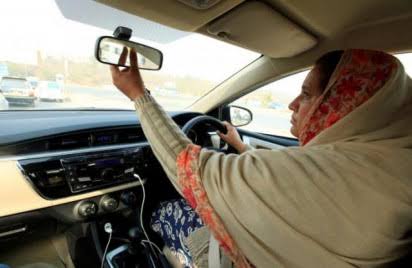
Before the engine starts: doors closed, seat positioned so you can fully depress the pedals with a slight bend at the knee, steering reachable with bent elbows, head restraint level with your ears, mirrors adjusted, seatbelt on. Done in the same order every time it takes fifteen seconds.
02
Steering
Hands at roughly nine and three, feeding the wheel rather than crossing your arms. Look where you want to go, not at the bonnet. The car follows your eyes more reliably than most learners expect.
03
Braking
Progressive pressure, then ease off as the car stops so it settles rather than jolts. Brake early and gently instead of late and hard, and leave more distance than feels necessary.
04
Acceleration
Smooth and gradual. Sudden throttle unsettles the car and wastes fuel; in traffic it achieves nothing because you arrive at the same queue.
05
Clutch and gears
In a manual, the clutch is raised to the biting point and held there briefly before the car moves. Change up as the engine note rises, down before you need the power. Do not coast with the clutch depressed.
06
Mirrors
Interior mirror first, then the door mirror on the side you intend to move towards, then signal, then manoeuvre. Every lane change and every turn. Mirrors do not cover the blind spot, so a shoulder check is separate.
07
Indicators
Signal early enough to inform, not so early that it misleads. Cancel the indicator afterwards — a signal left running is worse than none, because other drivers act on it.
Parking
The manoeuvre learners fear most, and the one that is almost entirely technique rather than talent.
Reverse parallel parking
Pull alongside the space, align your rear with the car in front of the gap, reverse until your mirror clears its bumper, then turn towards the kerb. Stop, straighten, and reverse in. Slow enough that you can stop at any point is the whole technique.
Reverse bay parking
Reversing into a bay gives far better control and a much safer exit than driving in forwards. Line up one bay past your target, reverse with your eyes moving between both mirrors and over your shoulder.
Forward bay parking
Easier to enter, harder and more dangerous to leave, because you reverse out into moving traffic with limited view. Use it when the exit is clear.
Hill parking
Facing uphill, turn the wheels away from the kerb and leave it in first gear. Facing downhill, turn the wheels towards the kerb and leave it in reverse. Handbrake on firmly in both cases.
Judging the space
A space needs roughly one and a half times your car length to be comfortable. If you have to ask whether it fits, it probably does not.
Road Skills
What separates someone who can operate a car from someone who can drive in traffic.
Lane changing
Mirror, signal, blind-spot check, then move — in that order, never signal-and-swerve. Change one lane at a time and complete the move before considering the next.
Turning
Approach at a speed that lets you stop, position correctly before you arrive, and do not straddle lanes. Left turns need a check for motorcycles coming up your inside; right turns need a proper gap, not an optimistic one.
U-turns
Only where permitted and where you can see far enough in both directions. Signal, wait for a genuine gap in both directions, and commit in one movement rather than stopping halfway across.
Roundabouts
Give way to traffic already on the roundabout. Approach in the correct lane for your exit, signal your exit as you pass the one before it, and watch for vehicles cutting across lanes.
Overtaking
Only with a clear view of the road ahead, never on a solid centre line, never approaching a bend, crest or junction. If you have to ask whether there is time, there is not.
Following distance
Two seconds behind the vehicle in front on a dry road, considerably more in rain. Count it against a fixed point. Tailgating removes your only reaction margin and gains you nothing.
Defensive Driving
Assume other road users will make mistakes, and leave yourself room to absorb them.
Blind spots
Every car has areas the mirrors do not cover, and motorcycles fit inside them easily. A quick shoulder check before every lateral move is what mirrors cannot replace.
Hazard awareness
Scan far ahead rather than fixating on the bumper in front. Brake lights three cars up, a pedestrian near a kerb, a door opening on a parked car — all of these are warnings you can act on early.
Emergency braking
Firm, immediate pressure and keep steering. In a car with ABS the pedal will vibrate and the noise is normal; do not release it. Practise it once, with an instructor, somewhere safe, so the first time is not an emergency.
Motorcycles and pedestrians
Both are less visible and far more vulnerable than cars. Assume a motorcycle may be alongside you whenever you move sideways, and that a pedestrian near a kerb may step into the road.
Night driving
Reduce speed, increase following distance, dip your headlights for oncoming traffic, and do not look directly at their lights. Judging distance is harder in the dark than most drivers admit.
Rain and poor visibility
Braking distances lengthen considerably, road markings disappear and standing water pulls at the steering. Slow down, double your following distance, and use lights so you can be seen as well as see.
Theory — FAQs
Do I need to learn theory to drive? +
You need to know road signs, markings and basic road rules to drive safely and to handle the licence process. This section covers the material; the practical side is learned in the car.
Is this the official government theory test? +
No. The practice test on this website is educational only and is not an official test. Official testing is conducted by the Khyber Pakhtunkhwa Traffic Police.
Is theory included in your driving courses? +
Road signs and road-rule awareness are covered as part of practical training, because they only make sense in context. This page lets you study the same material in your own time.
What should I study before my first lesson? +
The cockpit drill and the sign categories are the two most useful things to arrive knowing. Everything else is easier to learn with the car in front of you.
Put It Into Practice
Theory is the easy half.
Free
Theory practice test
10, 20 or 30 questions with answers.
Most popular
15 day course — Rs 20,000
Beginners through to real road driving.
Skill
Reverse & parking classes
Parallel, bay, forward and hill.
Skill
Hill & slope driving
Hill starts without rolling back.
Licence
Driving licence training
Documents, the 42–45 day wait, the test.
Theory Is the Easy Half
The rest happens in the car, with a female instructor beside you. Free pick & drop from your home.